"Our passions are the principal instruments of our preservation. It is, therefore, an enterprise as vain as it is ridiculous to want to destroy them."
Jean-Jacques Rousseau (1748)
Showing posts with label Nineteenth Century Art. Show all posts

Tuesday, 27 February 2018

The excited voyeur


I like to know as much about the artists of pictures posted here as I can discover, which is why, unlike some similar blogs, I don't just post pictures,   It is the nature of erotic art, however, especially in the nineteenth century, that much of it was anonymous and so identification is not always possible.  In the case of this delightful watercolour, I have been unable to find out anything about the painter whatsoever.  The file, sent to me, by my German friend, B, dates it at 1890 (which looks about right from the clothes) and contains the name Franz.  All research has drawn a blank.

It is such fun that I had to post it anyway, as a lady wearing a strap on dildo prepares to take another lady who is falling out of her peignoir.  Observing them from behind a scree is a very excited gentleman who is delicately holding his erection in his elegant white gloves.  Is he just going to watch the show (there is something very theatrical about this - a dressing room, perhaps) or is he planning to take a more active part?  A good time is about to be had by all!

Wednesday, 14 February 2018

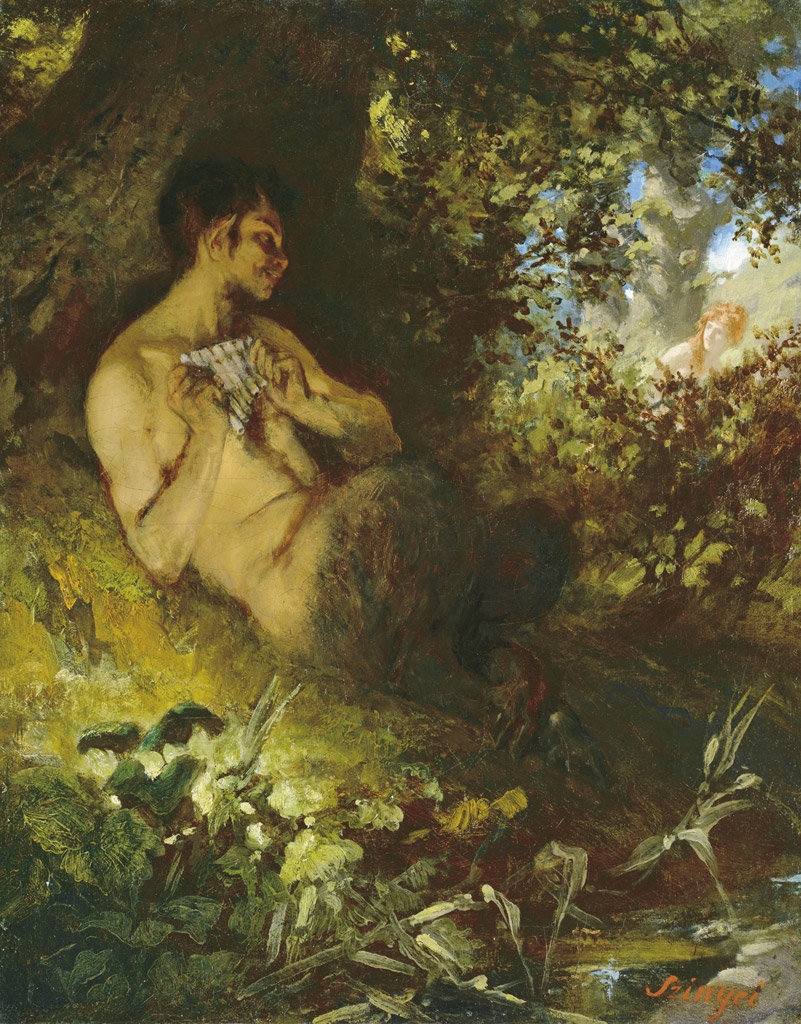
Nymph and Faun by Szinyei Merse Pál (1845-1920)


Here, for Valentine's Day, is a joyfully erotic depiction of a nymph and faun by the Hungarian painter Szinyei Merse Pál.  The faun is entranced by what he has found between the lovely nymph's spread thighs and his goat's penis has responded accordingly.  The nymph, looks equally delighted and, despite the mythological treatment, it says a lot about the joys of a young couple discovering each other's bodies.


Nymph and Faun (sketch) 1868


Amazingly, this picture was painted in around 1867, although it looks more modern. Painted when Szinyei Merse (in Hungary family names come first) was in his early twenties, it is one of a series of pictures he did of nymphs and fauns at the time.  In the others the faun is the dominant subject with the nymph glimpsed in the background.


Nymph and Faun (1868)


The erotic painting was only discovered and authenticated, by one of the artist's family, just over ten years ago.  It was an unusual work to discover in the oeuvre of such an establishment artist in Hungary.


Nymph and Faun (sketch) 1868


Born into an aristocratic family, he took private painting lessons before enrolling in the Akademie der Bildenden Künste München at the age of 19.  The coming of the Franco-Prussian War in 1870 saw him move to Genoa, although he returned home in 1873 and only painted occasionally as he had family problems.  For a decade, from 1882, he stopped painting entirely but after a successful exhibition of his work in 1894 he resumed painting and carried on until his death in 1920. He exhibited widely in Europe and the US, became the president of the Hungarian University of Fine Arts and also became a member of parliament.  

Saturday, 4 November 2017

The Victory of Faith by St George Hare


The Victory of Faith (1890)


This gently sensual picture actually has a religious theme and depicts two Christian women imprisoned in a Roman amphitheatre, while barely visible lions glower through the bars in the background.  The white girl is tied to a stone pillar on which a cross has been scratched. The dark skinned woman is supposed to be her Ethiopian maid, with them both being due to be thrown to the lions the next day.


The Gilded Cage (1908)


Hare (1857-1933) was an Irish painter who produced a number of pictures of chained women for religiously uplifting paintings.  This picture was well received at the time and is now on display in the National Gallery of Victoria in Melbourne to where it was donated in 1905.  Their tender touching of each other may be intended to depict their shared faith but now it seems likely that Hare copied the pose from a French erotic postcard which explains the simmering sexual overtones!  

Thursday, 26 October 2017

Symbolic Dance by Jan Ciągliński

Symbolic Dance (1898)


Here is a lovely and seductive  painting by the Polish painter Jan Ciągliński (1858-1913).  Although born in Poland he spent most of his career, other than a brief time in Paris. based in St Petersburg, Russia.  In his will, however, he bequeathed most of his works to Poland and many of them were on exhibition in Warsaw over the last few months. 


At the toilet (1909)


Symbolic Dance was painted in 1896 and is a frank portrait of two women, giving a real sense of two models  captured in the studio.  He produced a number of nudes and all have the same understated sensuality about them.


Kiss of the sun (1907)


He visited North Africa and the Middle East and painted a number of orientalist pictures, of the realistic, rather than the harem fantasy, type.  He taught at the Imperial Academy in St Petersburg and became a professor there in 1911. teaching many well known Russian painters.

Tuesday, 17 October 2017

The supportive tree - Persian couple


Many years ago I had a girlfriend who was an air hostess (as they were then called) for a Middle Eastern airline and she had several friends from Iran Air.  Goodness me, those Iranian ladies were lovely!  Today's Iran, of course, is what used to be known as Persia.

Here is the first example of Persian erotic art I have posted, in this anonymous but charming painting, done sometime in the nineteenth century, of a gentleman taking his lady from behind and, indeed, from his angle of attack, up the arse.  Now Triple P, of course, favours the rear entry position, more often than not (to the extent that a former girlfriend moaned that most people considered her bust her best feature but Triple P never bothered to look at it) but the standing up position does require some adjustment as regards angle of attack, especially if the lady is petite. In this position, having something for the lady to brace against is useful as it enables her to present her rear end in a more accessible way.  This lady has found a perfect young tree for the purpose (although we question, from a horticultural point of view, a tree with such a thick trunk but small upper branches).

My first lady against a tree came (so to speak) about twenty years ago with our particular friend S, from Vancouver.  We were attending an insurance conference at the splendid Banff Springs Hotel in Alberta and after the conference dinner decided to walk back via a small detour into the woods (S wanted to see the Bow Falls in the moonlight, or some such).  S needed to relieve herself and claimed she couldn't wait the few minutes it would take to get back to our room (actually she just enjoys doing it outside, if the truth be told) so we stepped a few yards into the trees.  Both of us then feeling more relaxed she suggested that I then "take her against the tree" (I suspect she used a rather more vulgar word).  So, with her suitably braced on the trunk (arms out in front of her, evening dress up around her hips), I did. Treemendous!

Saturday, 7 October 2017

Lesbian shunga: Women using a dildo by Chōkyōsai Eiri (1801)


Back in 2013 the  British Museum ran a splendid exhibition called Shunga sex and pleasure in Japanese art, which featured the largest selection of Japanese erotic pictures seen on display in Britain to date.  Given what often looks like a concerted effort by parts of society in Britain at present to increasingly follow America's conservative views, rather than more liberal, continental Europe's, on erotic material it was good to see the British Museum taking this on in such a serious way. 

This picture of a woman about to try out a tie-on dildo on her companion is by Chōkyōsai Eiri, who was active for less than a decade around the turn of the eighteenth to nineteenth centiries.  This picture is one of thirteen from his only known printed erotic work Fumi no kiyogaki from around 1801.  He seemed to mainly specialise in portraits of beauties.

The woman with the dildo holds a container of cream and is saying "As we're going to do it like this I'll put lots of cream on it, so really make yourself come." She says that the cream is needed as the dildo is such a big one.  The other girl has her hand on the dildo and is telling her to stick it in quickly as she wants to come five or six times.  Given its depiction as black, the dildo was probably made of ebony.  Wooden dildos were known as mokuzō but buffalo horn and tortoiseshell ones were common as well.

It's interesting to note that these women aren't lesbians in a relationship but are probably ladies in waiting in a samurai's home, so given the harem-like, women only environment they are just having sex to provide sexual relief rather than because they are in a romantic relationship.  These tie- on dildos could also be attached to a woman's ankle for solo masturbation.

Monday, 25 September 2017

Bons Souvenirs by Zichy


It's always difficult to propose that any one individual is pre-eminent in his or her particular area of expertise, as there are always a number of other claimants who could validly be considered for the premier position.  In the field of erotic art, however, Agent Triple P would venture that you would be hard put to nominate a name to go up against Hungarian artist Mihály Zichy (1827-1906).  A conventional painter and illustrator as well, his erotic pictures demonstrate a sense of movement, brilliant draftsmanship and sexual passion very rarely displayed in other erotic genre works.  

We'll have more of his pictures another day but just wanted to post this splendidly passionate (and athletic!) example as a taster.


Friday, 15 September 2017

Lovers by Jean-François Millet

Pair of lovers


 In some ways it is something of a surprise to discover that the French realist painter Jean-François Millet (1814-1874) produced erotic works. His pictures of peasants toiling in the landscape are far from the passion exhibited in the two drawings here but, then again, if he saw sex as a natural part, and perhaps a brief escape from, the hard life of the peasant (such as his parents) then perhaps it is not such a surprise after all. The pencil drawing above, which is the the collection of the Museum of Fine Arts in Budapest is a passionate depiction of rear entry sex which may be designed to echo the ways of the animals in the fields over which Millet walked, collecting material for his paintings. The girl has a wonderfully ecstatic expression and her arm disappears between her legs, surely reaching for her lover's member. 


Nymph and satyr 


This is another pencil drawing showing a nymph performing fellatio on a goat legged satyr or even, as some would have it, the devil. One of Millet's friends was Honoré Daumier whose ability to draw figures was much admired by Millet who copied his approach to figure work. Daumier produced his own erotic works and it would be interesting to know if the two artists shared their erotic works with each other.

Thursday, 31 August 2017

Tristan and Isolde by Rogelio de Egusquiza y Barrena (1845-1915) Tristan und Isolde: Death (1910)


Tristan and Isolde are two of the great lovers of legend and since their first literary appearance, as Tristan and Iseult, in 12th century Franco-Norman poetry, there have been many versions of their story.  Like Romeo and Juliet, Paolo and Francesca and Anthony and Cleopatra, it is a doomed love which suited the Victorian sensibility.  Matters are complicated in that the story is a love triangle in that Tristan is sent by his uncle, King Mark of Cornwall, to bring back the Irish princess Isolde to be Mark's bride.  However, on the way back the two take a love potion.  Depending on the version of the story this is either accidentally or Isolde takes the potion destined for her and King Mark and gives it to Tristan instead, thus becoming a typical (for the Victorians) predatory woman.  The two fall in love but King Mark doesn't learn of their affair for some time. When he does he decides to hang Tristan and burn Isolde at the stake but Tristan escapes, rescues Isolde and flees to the forest where they are not discovered again for some years.  Eventually Mark persuades Tristan to return Isolde to him and he is banished to Brittany where he marries a woman, also called Iseult ( not coincidentally).


Tristan and Isolde: Life (1912)


In one version of the story, Mark treacherously kills Tristan, while he is playing the harp, with a poisoned lance. In the other version Tristan is injured in a fight with other knights and sends his friend to bring Isolde, who is the only person who can heal him, across the sea.  His friend is told to display white sails on his ship if he is bringing back Isolde and black if he is not. However, Tristan's jealous wife, sick of being an Isolde substitute lies to him about the colour of the sails and Tristan, thinking that Isolde no longer cares for him, dies of grief.  On arriving in Brittany Isolde also dies on seeing Tristan's body and this is the scene depicted in Egusquiza's painting.


Study for Isolde (1893)


It is not surprising that such a melodramatic story appealed to the Victorians and many artists of the time did their own paintings of the couple, mostly full of medieval backdrops and costume.  Egusqueza's version has a rare eroticism about it with Isolde barely dressed in the flimsiest of,  garments, her breasts exposed. He based Isolde's figure on a nude study he had done some years before, adding the lightest drapery to the figure for the painting.   This was not a random drawing, later re-used for unconnected paintings years later, in the manner of Delacroix; he was already planning his Tristan and Isolde painting back in 1893.


Study for Isolde (1896)

Egusqueza came from a well-off family from Santander. in the north-western, Basque area of Spain and studied art in Madrid and then Paris. After some travel he returned to Paris and stayed there until a one year visit to Rome.  In 1876 when back in Paris, he first heard the music of Richard Wagner and from then on developed a fixation on the operas of the composer.  He later got to know Wagner and drew his portrait. 


Kundry (1894)


He started to feature Wagnerian themes in his paintings, although more often illustrating characters rather than actual scenes.   This drawing is of Kundry, the high messenger of the Grail, from Wagner's final opera Parsifal.  Wagner handed Egusquiza a copy of the manuscript of Parsifal for him to look at in 1880 and the painter attended the premier in Bayreuth in 1882.


Kundry (1906)


Egusqueza knew Wagnjer's operas intimately and played the music himself on the piano.  He began to attend performances of the operas in Bayreuth.  He started work on his Tristan and Isolde project in the early eighteen nineties and knew that he wanted to produce  paintings illustrating two key scenes from the opera, Firstly, the finale of Act III with Isolde's death upon the body of Tristan (in Wagner's version of the legend Tristan is still (barely) alive when Isolde finds him on the beach).


Tristan and Isolde: life (1893)


The second painting was to depict Tristan and Isolde alive in the night (from Act II).  The opera itself is about the tensions between night and day with the lovers embracing the night, which enables them to pursue their amorous encounters undiscovered.  It is about life and death too, of course, and Wagner was influenced by the rather pessimistic views of philosopher Artur Schopenhauer, and through Wagner, Egusqueza embraced his views too.  In this early rendering by the artist, a diaphanously clad Isolde is embraced by the warrior Tristan.


Tristan and Isolde (1896)


The figures seem to be enveloped in dark. Egusquiza had written a book on stage lighting and was very aware of the light effects he wanted in his pictures.  The final painting of the lovers alive was not completed until 1912, three years before the artist's death.  Both are large canvases, some five feet by eight.


Tristan and Isolde 1906


In this drawing, Egusquiza presents his final composition for the lovers. Isolde's arm is moved from the initial sketches so that she holds Tristan's wrist, linking them in death.  It was another five years before the final painting was first exhibited at the Salon of the Société Nationale des Beaux-Arts in Paris in 1911, where it was rapturously received. Privately owned, Tristan and Isolde: Death  was not seen again in public until a retrospective of the artist in his home town of Santander in 1995.  It made a huge impact and became well known as a result.  In 2000 it was bought by the Bilbao Fine Arts Museum where it hangs today.  Tristan and Isolde: Life is now just forty five miles away in the Museum of Modern and Contemporary Art of Santander and Cantabria.

Egusquiza, through his intimate knowledge of Wagner's opera, has produced a painting that matches the passion and tragedy of the music and is much more than a man and a woman in medieval clothes, like most of the other depictions of the characters.