"Our passions are the principal instruments of our preservation. It is, therefore, an enterprise as vain as it is ridiculous to want to destroy them."
Jean-Jacques Rousseau (1748)

Monday, 28 May 2018

Mutual masturbation for International Masturbation Day


Well, there isn't such a thing as mutual masturbation, of course, but these two nineteenth century ladies seem happy enough.  Today it is hot and sunny in the South East of England so I am going over to my particular friend Angela's house for skinny dipping with her and her girlfriend, J.  The plan is that we all then perform for each other, in celebration!

Tuesday, 8 May 2018

I Modi 2: Alcibiade et Glycere after Agostino Carracci and Giulio Romano


Here is the second engraving from the book of erotic sonnets I Modi, published in 1520.  As I noted in my post on the first of these, they were based on paintings by Giulio Romano, as engraved by Marcantonio Raimondi then reconstructed by Agostino Carracci and reworked by Jacques Joseph Coiny in 1798.

The other engravings in the series all relate to legendary or historical lovers but while Alcibiade was an Athenian statesman and general in the fifth century BC, Glycere was a Greek courtesan in the fourth century BC.  Their depiction as a couple is, therefore, pure fantasy with no mythical or historical precedent.  It is merely an excuse to show an athletic man leaping into the breach of a rather surprised looking woman.

Wednesday, 25 April 2018

Two women, one in black stockings


Here is a lovely photograph dating from around the end of the nineteenth century or the beginning of the twentieth century.  Anonynous, of course, as was typical for the period, it is a nice enough composition but is made by the pale eyes of the woman on the left looking directly at the camera.  "This is just lovely.' she appears to be thinking, while her companion concentrates on the job in hand.

Wednesday, 28 March 2018

Tenndresse from Les Chansons de Bilitis by Georges Barbier


This lovely illustration is by French artist Georges Barbier (1882-1932). Barbier didn't have his first exhibition until he was 29 years old but it was a great success and led to a career doing book, magazine and fashion illustrations. He also worked on theatrical set designs and costumes, including for the Folies Bergère, as well as designing glass and jewellery. He died, comparatively young, at the age of 50. 


These pictures come from a 1922 edition of Les Chansons de Bilitis by Pierre Louÿs. This work consisted of 143 prose poems with a lesbian theme which Louÿs claimed were translated from the works of an ancient Greek female poet and courtesan called Bilitis, who was a contemporary of Sappho. At the time they were first published, in 1894, they were accepted as translations of genuine ancient texts but in fact they were all created by Louÿs inspired by an encounter with a dancing girl in Algeria. In fact the dancing girl in question, Meriam ben Atala, even received a dedication as 'MbA' in the book. 


Its theme was controversial, not least because his treatment of lesbians is non-judgemental and sympathetic, whereas most lesbian characters in French literature had been portrayed in a less positive manner. Baudelaire (who was the subject of a censorship trial in 1857 for his work Les Fleurs du Mal, over lesbian themes) had referred to them as "damned women". Many books which tried to address lesbian themes or had lesbian scenes were banned in France in the second half of the nineteenth century. 


Louÿs got away with it by his erudite, sensuous and elegant writing and the fact that people believed that they were reading a translation of a genuine ancient text, with historical distance making the whole thing acceptable. The same applied to his novel, Aphrodite, published two years later and also featuring lesbian characters in Ancient Greece, 


The first illustration in this post accompanies the following text from the poem Tendresse: 

Ferme doucement tes bras, comme une ceinture, 
sur moi. Ô touche, ô touche ma peau ainsi! 
Ni l’eau ni la brise de midi ne sont plus 
douces que ta main. 

Aujourd’hui chéris-moi, petite soeur, c’est 
ton tour. Souviens-toi des tendresses que je 
t’ai apprises la nuit dernière, et près de moi 
qui suis lasse agenouille-toi sans parler. 

Close your arms gently, like a belt, 
on me. O touch, O touch my skin so! 
Neither the water nor the midday breeze are not anymore 
as sweet as your hand. 

Today cherish me, little sister, it is 
your turn. Remember the tenderness 
Taught you last night, and get close to me 
Who is tired, kneel down without speaking. 

The wonderful Art Nouveau illustrations by Barbier complement the text perfectly. 

Tuesday, 27 February 2018

The excited voyeur


I like to know as much about the artists of pictures posted here as I can discover, which is why, unlike some similar blogs, I don't just post pictures,   It is the nature of erotic art, however, especially in the nineteenth century, that much of it was anonymous and so identification is not always possible.  In the case of this delightful watercolour, I have been unable to find out anything about the painter whatsoever.  The file, sent to me, by my German friend, B, dates it at 1890 (which looks about right from the clothes) and contains the name Franz.  All research has drawn a blank.

It is such fun that I had to post it anyway, as a lady wearing a strap on dildo prepares to take another lady who is falling out of her peignoir.  Observing them from behind a scree is a very excited gentleman who is delicately holding his erection in his elegant white gloves.  Is he just going to watch the show (there is something very theatrical about this - a dressing room, perhaps) or is he planning to take a more active part?  A good time is about to be had by all!

Wednesday, 14 February 2018

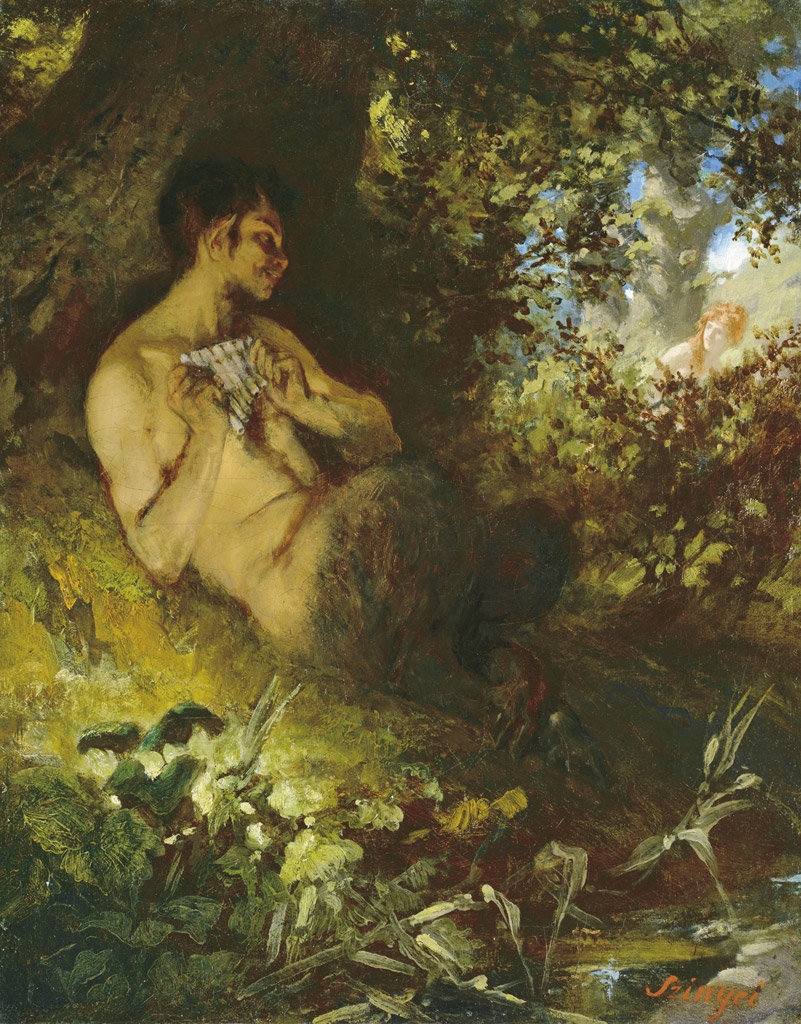
Nymph and Faun by Szinyei Merse Pál (1845-1920)


Here, for Valentine's Day, is a joyfully erotic depiction of a nymph and faun by the Hungarian painter Szinyei Merse Pál.  The faun is entranced by what he has found between the lovely nymph's spread thighs and his goat's penis has responded accordingly.  The nymph, looks equally delighted and, despite the mythological treatment, it says a lot about the joys of a young couple discovering each other's bodies.


Nymph and Faun (sketch) 1868


Amazingly, this picture was painted in around 1867, although it looks more modern. Painted when Szinyei Merse (in Hungary family names come first) was in his early twenties, it is one of a series of pictures he did of nymphs and fauns at the time.  In the others the faun is the dominant subject with the nymph glimpsed in the background.


Nymph and Faun (1868)


The erotic painting was only discovered and authenticated, by one of the artist's family, just over ten years ago.  It was an unusual work to discover in the oeuvre of such an establishment artist in Hungary.


Nymph and Faun (sketch) 1868


Born into an aristocratic family, he took private painting lessons before enrolling in the Akademie der Bildenden Künste München at the age of 19.  The coming of the Franco-Prussian War in 1870 saw him move to Genoa, although he returned home in 1873 and only painted occasionally as he had family problems.  For a decade, from 1882, he stopped painting entirely but after a successful exhibition of his work in 1894 he resumed painting and carried on until his death in 1920. He exhibited widely in Europe and the US, became the president of the Hungarian University of Fine Arts and also became a member of parliament.  

Sunday, 11 February 2018

Amorous Couple by Nicolas Lancret


This painting by Nicolas Lancret (1690-1743) is in stark contrast to the Fête galante paintings for which he was most famous  Fête galante was a term invented to describe Anotoine Watteau's (1684-1721) paintings of aristocrats in ball or fancy dress clothes disporting themselves in an idealised countryside.

Lancret, who was thrown out of the Académie Royale for bad behaviour, joined the workshop of Watteau's teacher, Claude Gillot,and by the 1720, after the death of Watteau and Gillot, monopolised the fête galante style, eventually producing over 700 paintings.

He died in 1743, at the age fifty three, two years after marrying an eighteen year old.  This picture, while not explicit, has a joyous earthiness about it, as the man pulls up the girl's shift to reveal her plump bottom.  good kissing, too!

Tuesday, 23 January 2018

Two Women by Martin van Maële


Here is a juicily explicit painting by French illustrator Martin van Maële (1863-1926).  This illustration appeared in a 1910 edition of Un été à la campagne: correspondance de deux jeunes parisiennes  by  Gustave Droz (1832-1895), a French writer who was also, coincidentally, an illustrator whose work appeared in La Vie Parisienne.  

Van Maële was from Boulogne in France but worked in Paris and Brussels. He first became well known for doing the illustrations for the French edition of HG Wells' The First Men in the Moon in 1901 but it is his erotic illustrations for which he is best known today.  We will have more of his work in due course.

Wednesday, 17 January 2018

Leda and the Swan by Giovanni Boldini


I will shortly be re-uploading a post on Italian artist Giovanni Boldini, over on Venus Observations.  In the meantime, here is his version of Leda and the Swan.

The Greek legend of Leda and the Swan, has the God Zeus, in the form of a swan seducing (or raping, depending on the version), Leda, the daughter of the King of Aetolia.  Obviously not too traumatised by the event that night she also had sex with her husband and in due course gave birth to two eggs which produced Helen (of Troy) and  Clytemnestra from one egg, and Castor and Pollux from the other.

The subject has enabled artists for centuries to produce images of ecstatic looking women in copulatory poses while claiming that they are just illustrating an acceptable classical subject.  Boldini's version is certainly at the more explicit end of the scale, with the swan between Leda's legs, its feet grasping her thighs as it presses its nether regions into her groin while she looks appropriately overcome.

Thursday, 4 January 2018

Ménage à trois from the nineteenth century


My particular friend B send me this amusing photograph of two ladies and a young (he looks younger than the usual sturdy middle aged men you tend to get in these sorts of pictures) gentleman in a nicely composed pile.  This is probably from a French erotic postcard, although latterly it has been used as the cover of a book on German erotica.   Dating these pictures is always problematic and without a very good knowledge of nineteenth century continental millinery it is quite tricky.

The shorter stockings, lingerie, hair styles and less crisp photography would tend to suggest the 1880s or 1890s.  I like the fact that the two ladies are smiling in this one.  One girl happily frigs the man and herself while the other appears to demonstrate pinpoint accuracy in giving him a salty drink.  Of course cameras at the time couldn't capture a lady in mid flow like this, so a little post photographic manipulation would have been needed!

Tuesday, 26 December 2017

Spring scene by Hosoda Eishi (c1790)


Time for some more al fresco sex with this painting by the Japanese artist Hosoda Eishi (1756-1829). Most Japanese erotic art was in the form of woodblock prints and actual paintings, such as this, are rarer. The ability to use more subtle shading gives them a particular delicacy, however. Eishi, unusually for an artist at the time, was an aristocratic Samurai, as is his male protagonist here. The woman, however, is wearing a maid's clothing. This picture is from a set of twelve paintings of lovers, depicted at different times of the year. The river in the background is the Sumida in Edo (now known as Tokyo). On the right, on the far bank, can be seen the gateway to the Mimeguri shrine which is still there today. This area, at the time of the painting was a popular place to look at flowers. 


Here we have the view from close to the river, looking towards the Mimeguri shrine, today. You can just glimpse the pale ochre-coloured Sumida river on the left hand side of the photograph at the chest height of the man in a blue jacket Today, technically, despite the urbanisation of Tokyo, you could still have al fresco sex on this spot as it is the site of Kuntsu Sumida Park, a narrow open space which follows the river bank for just under a mile. The shrine is no longer visible from the spot across the river as the view is blocked by the elevated Metropolitan Expressway 6, which runs between it and the river bank.

Wednesday, 20 December 2017

Watery frolics in the style of Peter Fendi


Here is a group of paintings which were thought, for many years, to be by Austrian artist Peter Fendi (1796-1842).   Fendi was a pioneer in colour printing and also designed a number of banknotes for the Austrian government in 1841.  


These pictures (part of a set of forty) were not published until 1910, however, which makes their provenance as being by Fendi doubtful.  Fendi didn't produce so much as a nude so it would be surprising if these were indeed by him.  Nevertheless, some still maintain that they are his work.


Whoever did them, they have a sprightly joy about them, as groups of ladies and a couple of very excited (but faceless) gentlemen disport themselves in the water in a very tidy landscape.  


The other prints from this set are all depicted as being indoors and feature equally athletic and and joyfully unrealistic figures.  We will look at them another time.

Sunday, 10 December 2017

I Modi 1: Angélique et Médor after Agostino Carracci and Giulio Romano


Back through the centuries for this piece of al fresco reverse cowgirl (as it would not have been called at the time!) action.  In a sylvan landscape a lady guides her lover's erection into her vagina while her companion gazes at it raptly.  We confess that this is still a sight that fills us with delight even after  nearly forty years!  No scrabbling around on the grass for this couple as they have a luxurious looking cushion and a large piece of fabric on which to disport themselves.


Marcantonio Raimondi


This picture has a rather convoluted history.  It is one of  a series of erotic engravings of sexual positions produced in book form under the title I Modi by Marcantonio Raimondi (1480-1534) in 1524.  An engraver, he based his pictures on a series of paintings produced by Giulio Romano (1499-1546) for the Duke of Mantua, Federico II Gonzago's new palazzo in Mantua.  Romano was unaware that Raimondi had used his paintings as the basis for his engravings until Raimondi was imprisoned by Pope Clement VII for producing them.  The  Pope ordered all copies of the books to be destroyed.  Romano escaped imprisonment as his paintings were a private commission and were not, unlike Raimondi's book, for public consumption.   


Pietro Aretino by Titian


The poet and author Pietro Aretino (1492-1556), after going to see Romano's originals, then composed sixteen erotic sonnets to accompany the pictures and he also helped get Raimondo released from prison.  A second edition of I modi was then published in 1527 which included Raimondi's illustrations and Aretino's sonnets, in the first known example of erotic pictures and text being included in one publication.

Apart from a few fragments in the British Museum, the 1527 edition is lost, although Aretino's sonnets survived.  Later Agostino Carracci (1557-1602) reconstructed the illustrations (he must have had access to at least a partial copy at that time, as his illustrations are very close to the British Museum fragments).  In 1798 another edition of I Modi was published in Paris with Carracci's engravings reworked by the French artist Jacques Joseph Coiny (1761-1809).  These are the illustrations we have today.


Angélique et Médor byToussaint Dubreuil (1561-1602)


The story of Angélique et Médor (all the illustrations in I Modi were of famous lovers of myth and history) comes from Orlando Furioso by Ludovico Ariosto (1477-1533).  Based on the much older Song of Roland (Roland and Orlando are the same person) it tells the story of Orlando's love for the pagan princess, Angélique who he married.  However, she began a passionate affair with the Saracen called Médor.   


Angélique et Médor by François Boucher (1763)


He carved her name into the bark of a tree but Orlando discovered it (you can just see his figure at the right of the engraving at the top of the post).  It was her betrayal that made him furioso.  Perhaps Roland, who as a Paladin of Charlemagne is a sort of French equivalent of Lancelot of King Arthur's round table, was boring in bed and didn't indulge in athletic al fresco girl on top bonking. Orlando carved the inscription off the tree and imprisoned his wife in a tower.   However, she told Orlando that he couldn't carve away her love for Médor and eventually Angélique killed herself, in a typical end for the sexually aggressive woman in European literature.


Angélique et Médor by Bartholomeus Spranger (1580)


The story of Angélique et Médor is not so well known today but during the renaissance and after the story of the lovers was an inspiration to a number of artists, although none display the graphic eroticism that Giulio Romano's lost painting would have had, given the engravings based upon it.

Friday, 1 December 2017

Two Reflected Ladies: French Postcards by Grundworth


Bob Guccione, in many of the pictorials he shot for Penthouse, often used mirrors in his pictorials. Proving that there is nothing new in photographic erotica here are some studies from a series produced by the French postcard studio Grundworth. 


 Like most of these postcard publishing outfits of the time, little is known about it, as, despite the widespread circulation of these cards (which were certainly tolerated amongst troops during the Great War) their production and distribution was illegal in France, hence the requirement for anonymity.


Grundworth produced erotic postcards from the 1890s to the 1930s.  Given the time span and a number of different styles the name is unlikely to represent an individual photographer but more likely a group of photographers who were, perhaps better known, but wanted to hide their real identities.  Grundworth cards were very collectable and are even more so today.  You can expect to pay from £75 to £150 each for these little treasures.


These photographs are often dated at 1935 but the gartered stockings probably indicate a slightly earlier date in the twenties, however.  These pictures are also sometimes known as ''women on a chaise longue' but the width of the piece of furniture is more likely to indicate some form of divan or other bed.

Saturday, 4 November 2017

The Victory of Faith by St George Hare


The Victory of Faith (1890)


This gently sensual picture actually has a religious theme and depicts two Christian women imprisoned in a Roman amphitheatre, while barely visible lions glower through the bars in the background.  The white girl is tied to a stone pillar on which a cross has been scratched. The dark skinned woman is supposed to be her Ethiopian maid, with them both being due to be thrown to the lions the next day.


The Gilded Cage (1908)


Hare (1857-1933) was an Irish painter who produced a number of pictures of chained women for religiously uplifting paintings.  This picture was well received at the time and is now on display in the National Gallery of Victoria in Melbourne to where it was donated in 1905.  Their tender touching of each other may be intended to depict their shared faith but now it seems likely that Hare copied the pose from a French erotic postcard which explains the simmering sexual overtones!  

Thursday, 26 October 2017

Symbolic Dance by Jan Ciągliński

Symbolic Dance (1898)


Here is a lovely and seductive  painting by the Polish painter Jan Ciągliński (1858-1913).  Although born in Poland he spent most of his career, other than a brief time in Paris. based in St Petersburg, Russia.  In his will, however, he bequeathed most of his works to Poland and many of them were on exhibition in Warsaw over the last few months. 


At the toilet (1909)


Symbolic Dance was painted in 1896 and is a frank portrait of two women, giving a real sense of two models  captured in the studio.  He produced a number of nudes and all have the same understated sensuality about them.


Kiss of the sun (1907)


He visited North Africa and the Middle East and painted a number of orientalist pictures, of the realistic, rather than the harem fantasy, type.  He taught at the Imperial Academy in St Petersburg and became a professor there in 1911. teaching many well known Russian painters.

Tuesday, 17 October 2017

The supportive tree - Persian couple


Many years ago I had a girlfriend who was an air hostess (as they were then called) for a Middle Eastern airline and she had several friends from Iran Air.  Goodness me, those Iranian ladies were lovely!  Today's Iran, of course, is what used to be known as Persia.

Here is the first example of Persian erotic art I have posted, in this anonymous but charming painting, done sometime in the nineteenth century, of a gentleman taking his lady from behind and, indeed, from his angle of attack, up the arse.  Now Triple P, of course, favours the rear entry position, more often than not (to the extent that a former girlfriend moaned that most people considered her bust her best feature but Triple P never bothered to look at it) but the standing up position does require some adjustment as regards angle of attack, especially if the lady is petite. In this position, having something for the lady to brace against is useful as it enables her to present her rear end in a more accessible way.  This lady has found a perfect young tree for the purpose (although we question, from a horticultural point of view, a tree with such a thick trunk but small upper branches).

My first lady against a tree came (so to speak) about twenty years ago with our particular friend S, from Vancouver.  We were attending an insurance conference at the splendid Banff Springs Hotel in Alberta and after the conference dinner decided to walk back via a small detour into the woods (S wanted to see the Bow Falls in the moonlight, or some such).  S needed to relieve herself and claimed she couldn't wait the few minutes it would take to get back to our room (actually she just enjoys doing it outside, if the truth be told) so we stepped a few yards into the trees.  Both of us then feeling more relaxed she suggested that I then "take her against the tree" (I suspect she used a rather more vulgar word).  So, with her suitably braced on the trunk (arms out in front of her, evening dress up around her hips), I did. Treemendous!

Wednesday, 11 October 2017

Ménage à trois by French School


Here is a lady entertaining two gentleman or two gentlemen entertaining a lady, depending on your viewpoint, in an anonymous painting of the French School from the eighteenth century.  While being taken from the rear the lady contemplates the other man's erection.  The scene, especially given the man on the right's posture, is rather languid and gives the impression of the enjoyment of some hours of ongoing frolics, rather than a single frantic scene.  He is holding what looks like a pearl necklace.  Is it a gift, a reward or a payment?

Following the death of Louis XIV in 1715, France (or at least Paris - Louis XIV's palace of Versailles was closed down for a number of years ), under the regency of the Duc d'Orléans and then Louis XV, saw a period of libertarianism embodied by the rocaille style of art as practised by Watteau and Boucher.  There were less pompous historical scenes than in the previous baroque style and more frivolous subjects and nudes.

A graphic, fully-rendered, erotic painting such as this was unusual, with most sexual pictures being confined to engravings and drawings.  The artist doesn't have the talent of a Watteau, Boucher or, later, Fragonard but it is a nicely composed scene of  the sort of sexual frolic that the period became notorious for.


Saturday, 7 October 2017

Lesbian shunga: Women using a dildo by Chōkyōsai Eiri (1801)


Back in 2013 the  British Museum ran a splendid exhibition called Shunga sex and pleasure in Japanese art, which featured the largest selection of Japanese erotic pictures seen on display in Britain to date.  Given what often looks like a concerted effort by parts of society in Britain at present to increasingly follow America's conservative views, rather than more liberal, continental Europe's, on erotic material it was good to see the British Museum taking this on in such a serious way. 

This picture of a woman about to try out a tie-on dildo on her companion is by Chōkyōsai Eiri, who was active for less than a decade around the turn of the eighteenth to nineteenth centiries.  This picture is one of thirteen from his only known printed erotic work Fumi no kiyogaki from around 1801.  He seemed to mainly specialise in portraits of beauties.

The woman with the dildo holds a container of cream and is saying "As we're going to do it like this I'll put lots of cream on it, so really make yourself come." She says that the cream is needed as the dildo is such a big one.  The other girl has her hand on the dildo and is telling her to stick it in quickly as she wants to come five or six times.  Given its depiction as black, the dildo was probably made of ebony.  Wooden dildos were known as mokuzō but buffalo horn and tortoiseshell ones were common as well.

It's interesting to note that these women aren't lesbians in a relationship but are probably ladies in waiting in a samurai's home, so given the harem-like, women only environment they are just having sex to provide sexual relief rather than because they are in a romantic relationship.  These tie- on dildos could also be attached to a woman's ankle for solo masturbation.

Monday, 2 October 2017

Lesbian Lovers by Paul Avril


 Here is a rather sweet illustration, from French artist Paul Avril, of two young ladies enjoying each other's company.  Perhaps they are scared of the stormy weather, given there is a rather violent flash of lightning and an ominous looking sky outside, and are comforting each other.  Beautiful work on the drapery.

Avril was born Édouard-Henri Avril in Algiers in 1849. He studied at the École des Beaux Arts in Paris in the eighteen seventies.  He illustrated both conventional novels and what the French called galante literature which were privately published erotic novels.  He died in 1928.


This example comes from a 1909 edition of just 310 copies of the 1741 novel Histoire du Saturnin Portier du Chartreux by Gervaise de Latouche, which is a story about illicit love between monks and nuns.  According to the original caption, the lady on the right  is feeling "her pleasure mount by degrees".

Avril was one of the greatest erotic illustrators of all time and I will feature more of his work soon.